Politics Blog 2: Chicken is Money. Money is Speech.

I’d rather not rehash the whole Chik-Fil-A thing, but I want to cover why it was important. In 2010, in the case of Citizens United  v Federal Election Commission, the Supreme Court ruled that the First Amendment prohibited the government from restricting independent political expenditures by corporations and unions. In other words, corporations and unions can give unlimited money to political campaigns because a) corporations and unions are people, whose freedom of speech is protected by the Constitution and b) money is speech.

You’re thinking, “Who cares? I don’t own a corporation, belong to a union or have a ton of money. So why does this matter, and what could this possibly have to do with Chik-Fil-A?”

Here’s why it matters. You have a limited amount of income that you’re willing to donate to a political campaign. Most of the people reading this will either not contribute to the Presidential campaign this year or will contribute less than $50. If you do give to a campaign, it will be based on your own personal political leanings. However you will give every penny you make to corporations in exchange for goods and services without regard to their political leanings. Corporations have way more money and way more incentive to give to political campaigns. Elected officials create and enforce legislation that has a direct impact on their earning potential, so they are much more likely to donate based on their business interests rather than the interests of the country.

Warning: This is where I’m going to start sharing my opinions. If you’re offended by the opinions of others, this is your chance to just stop reading.
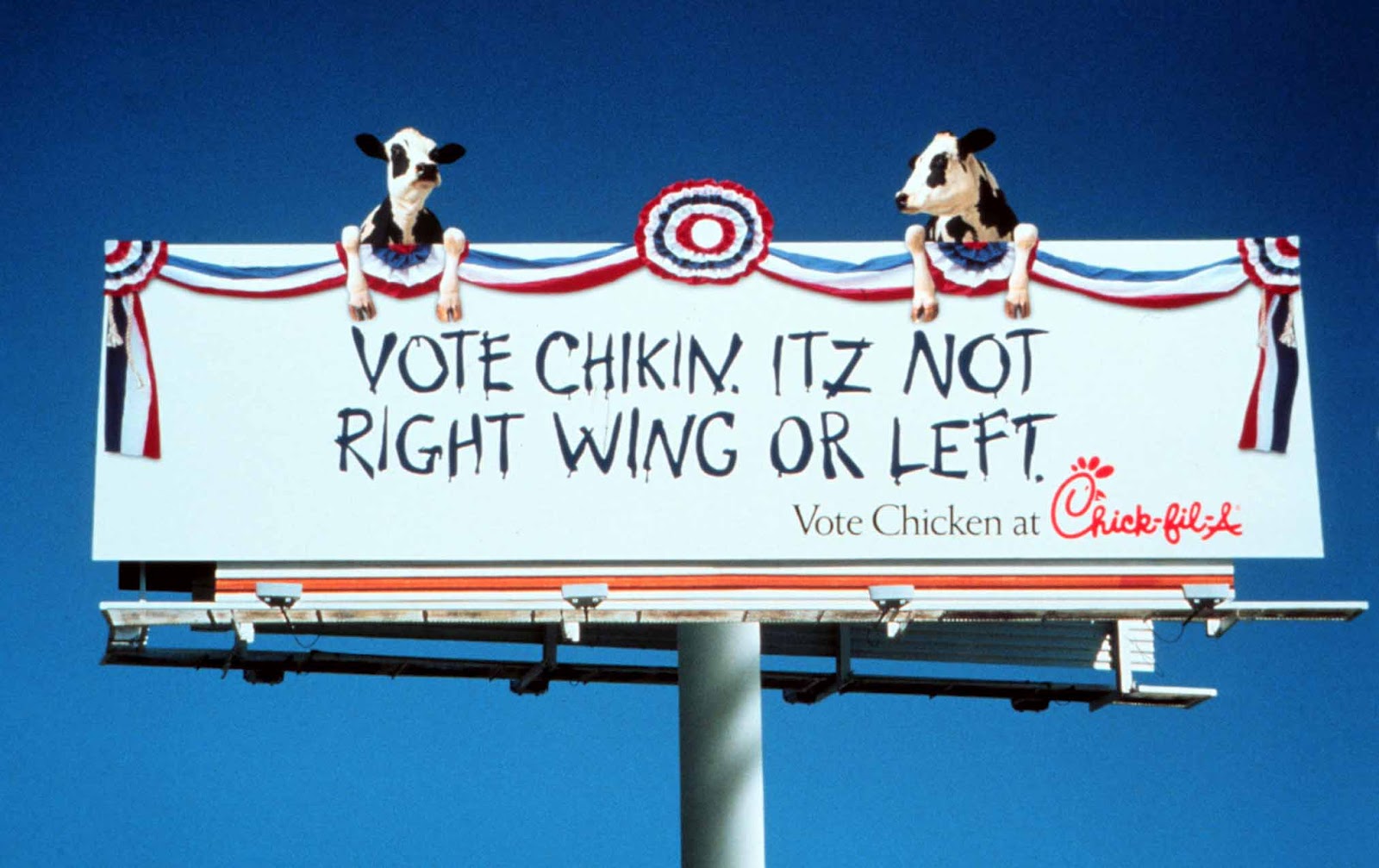
So why was the Chik-Fil-a hubbub important? Because it exposed the fact that they donate a copious amount of money to political action committees that lobby for policies that directly contradict my personal philosophy. Specifically, they spend money to prevent gay couples from being allowed to get married, or to share any of the legal benefits of being married. So I had to make the decision to no longer spend money there, because I didn’t want my money to contribute to a cause I don’t believe in.

We have one vote, but we have lots of dollars. Now because of Citizens United we must spend those dollars with the same caution with which we cast our vote. This is difficult for me, because I like to spend willie-nillie on things I want without wondering if my purchase is going to keep gay couples from getting married. I wouldn’t buy tuna from a company that snares dolphins with their nets or buy shoes from a company that uses child labor in a foreign country. It’s the same principle. The money we spend for the things we want has an immediate and direct impact on our lives and our world. And it means even more since the Citizens United ruling.

This political cycle or the next will likely bring this to a head. We’ll find that there’s a limit to the effectiveness of money. At a certain point, campaigns will have more than they can spend. They’ll buy all the TV time they can, and they won’t sway any more voters by spending more money. The effect of monetary volume has a limit. The bigger risk is of course that corporations will expect favors in exchange for their contributions.

We’ve been here before From around 1830, with the election of Andrew Jackson to around 1881 with the death of James Garfield, this was called “The Spoils System”. Huge campaign donors were given government jobs in exchange for their donations. We ended up with a government full of people looking out for their specific interests who were also not especially qualified to do the jobs they were given. That included not just political appointees but elected officials as well. Back then it was political bosses pulling the levers rather than corporations, but the effect is the same. Bosses were rich guys who usually owned the newspapers (and later the radio stations) in their regions. Their realm of political control was called a political machine. Selling political appointments was made illegal at the end of the Gilded Age. Political Bosses continued to weild power through the Great Depression. But eventually people were exposed to opinions that came from outside their bosses area of control. A few couragous politicians, who were put in place by the machines revolted and the system was changed.

Last time around the whole mess lasted for around a century, but so did newspapers. Technology changed much slower back then, so it took longer for the things influencing people to change. Now we can be exposed to new and different ideas because of our ever changing technology. We are closer to a one-world-experience than most Americans would admit. When people finally get sick enough of the current system, they’ll look beyond their pre-programmed news services and start to demand a change. Once the cry for change is loud enough, a few courageaous politicians will revolt against the system that put them in place and we’ll once again experience one of the bloodless revolutions that make America great.

Politics Blog 1: Civil Discourse or Civil War

A little over a year ago, I published a post about religion which lost me a few Facebook friends. Here’s the link. I didn’t set out to offend anyone, I just had something to say, and I said it. I have several friends who are Christians in the truest sense, who not only didn’t take offense, but accepted my right to believe what I believe. They probably prayed for me, but that’s fine. In that same spirit, today I am starting a short series of long blog posts to share some of my political views. If you’re someone who is offended by the opinions of others, turn back now.

I’ve always been very interested in politics. In the Republican primary of 1988, I was a Precinct Chairman in Jack Kemp’s Presidential campaign . I was 15 years old. I remember the shock on the faces of the people running that campaign when we met in person, and they realized I was a kid. Up to that point, I had only dealt with them by phone, and always delivered whatever I was asked. The first vote I cast was in 1990 for Clayton Williams, who was a Republican running for Governor of Texas back when that was unheard of. I campaigned for him and met him on a few occasions. Like many Republicans of his age, he’d once been a Democrat. He said, “I was a Democrat until Truman fired MacArthur.”

Ronald Reagan, who was a Democrat until 1962, famously said, “I didn’t leave the Democratic party. The party left me.” I’m making this point to show that’s it’s normal for an intelligent, engaged person to change their views over time if they’re exposed to and open to dissenting views. It’s okay to start as one thing and become another thing. That generation of Republicans was uniquely able to see the humanity in the Democrats of their age because they could remember a time when they would have agreed with them. President Reagan and Speaker Tip O’Neil where political rivals who disagreed on almost every important policy decision, but they were also close friends who could share a drink and a joke off the clock.

The modern Republican Party is eagerly awaiting the next Reagan. Yet we live in a time that cannot produce him.  We’ve lost our ability, not only to compromise, but to see the humanity in the people we disagree with politically. We demonize anyone with an opinion different from our own. Even outside of politics, if someone disagrees with us, we take it as a personal affront. How can we develop new ideas if we’re completely closed off to the opinions of others? How can we change the minds of our opponents if we don’t let them try to change ours? How will the new Reagan get in if the doors are all closed? During the recent Presidential primaries, the Republicans anointed each candidate at some point as their front runner. Each time they held them up to the light to see if they might be the next Reagan. All except one, John Huntsman, who probably was the next Reagan, but got drummed out of the primaries and it appears out of the party altogether because he served as Ambassador to China for the Obama administration, and he was espousing the politics of compromise.

The current political season is as mean and devoid of ideas as any I can remember. Over the last two decades we’ve become so divided by party politics, that now we all just sit in our corners reading and listening to news spun to reflect our opinions back on us and  shouting hateful things at the people in the other corner. I thought the last Presidential election would finally bring us a popular leader who would unite us again as a nation. I still think our President could have been that man, but the response to his election was for the right to move even farther right. The party of Reagan became the party of “no”. Speaker Boehner even said they would be the party of “Hell no.” I’ll take a moment to say here, that I think John Boehner would, in any other period in our recent history, have made an excellent Speaker. He’s compassionate and intelligent and understands the political necessity of compromise. He has, however, been undermined at every turn by his own party.

We started down this road after Clinton was elected in 1992, and Rush Limbaugh started his “America Held Hostage” series. He spent the next eight years being the crazy voice in the wilderness claiming everything the President did was part of a calculated plan to destroy the country. I doubt the real Rush Limbaugh has much in common with the radio Rush Limbaugh, just as I doubt the real Bill O’Reilly has much in common with the TV Bill O’Reilly. Those guys are entertainers who have created personas that sell a lot of ad time. I’m not comparing O’Reilly to Limbaugh because I think O’Reilly realizes he has a responsibility to center that character occasionally. My point is, Limbaugh’s angry right winger became a popular character, and a huge mass of people believed everything it said. Then more angry right wingers sprung up to sell ad time on more radio and TV stations. Follow that with the election of 2000, one of the closest in our history. It didn’t get contentious until it was over and there was no winner. Then we saw the birth of the angry left wing character. Fox News’ right wing slant was met with MSNBC’s left wing slant. Pile onto that a Supreme Court ruling that allows unlimited corporate campaign contributions and virtually unregulated Super PACs. Now we’re so far down the rabbit hole of conspiracy theories of secret Muslims and false birth certificates and socialist agendas that we can no longer find the truth in all the lies.

So what do you do? You have two men, the leaders of their parties, the smartest kids in the class run for President. You can’t have them tell blatant lies. So you have their surrogates on every morning news show telling the most egregiousness lies. You run ads saying one of them killed a guy’s wife or the other one wants to bring back the old welfare system. Then you put the actual candidates on stage to take the high road and refute the lies of the other guys surrogates. We all get worked into a lather and nothing gets accomplished. No one talks about policies.

In November, there will be people who will vote for one guy because they’re actually afraid of the other. There will be people who won’t vote at all because they’re turned off by the whole mess. Over the next few posts, I will be very open with you about who I will vote for and why. I’ll do this without saying a single disparaging thing about the other guy. I’ll tell you how I got to this place from where I started with Jack Kemp in ’88. I’ll also tell you why it’s important that you vote, regardless of whether you agree with my choice of candidate or not, and why it’s important for you to defend the rights of others to vote whether they agree with you or not. And finally, I’ll share my opinions on the modern political system, how it’s changed since Citizens United and where it will all end up. I’ll do all of this with a healthy dose of optimism and decency.

I know this isn’t my usual fare, but these are things that are important to me, and I want to share them. Bare with me, and I’ll promise to write a funny (to me) post once I’m through.