Finding my Mojo

I met Lisa  in the summer of 2002. Jacob had just turned three. I never had any children of my own, and I had no real experience with kids. I was about to turn thirty, and outside of my first marriage, which lasted four years, I’d mostly been independent. For the purpose of this blog post, independent means single and self absorbed. Picture Hugh Grant in “About a Boy” only uglier and with a smaller budget. I was an island.

Mojo Jojo
Mojo Jojo

What I didn’t know about kids at the time could have filled a library. One of the things I didn’t know was they’re always chucking their most beloved possessions out of car windows or into animal habitats at the zoo. Then they’re devastated because they’ve lost whatever item they just threw away. Even back then I was wise enough to know toddlers aren’t smart, but that kind of behavior indicates a special level of not smart.

One day, shortly after we started dating, Lisa called to tell me Jacob had tossed his stuffed Mojo Jojo toy out of her car window on the way to daycare, and he was heartbroken. Now we’re into comfortable territory for me, problem solving.

Problem: Toy has been tossed out the window of a moving car.
Challenge: Replace toy.
Risk of Failure: Low
Reward Potential: Huge
Difficulty Level: 5

Challenge Accepted!

The next day was Saturday, and I set out on my journey. I went to Toys R Us to buy a new Mojo Jojo. FAIL. I tried Wal-Mart. FAIL. So I called Lisa and probed a little on the origin of Mojo Jojo. It turns out one of Jacob’s grandparents had pulled the toy from a claw-machine while on a road trip.

Revised Problem: Tossed Toy came from a claw machine in another town.
Challenge: Find the same toy in a claw machine locally.
Risk of Failure: Medium
Reward Potential: Still Huge
Difficulty Level: 7

Challenge Accepted!

So I hit every pizza place, family-friendly restaurant and bowling alley within ten miles of my apartment. I’d park, go in, check the claw machine contents and leave. FAIL. FAIL. FAIL.

Mojo Jojo
My Mojo

That night I picked up Lisa to take her out. I asked her to show me where Mojo met his fate. We drove to the place, and there in the gutter was the beat up, wet, stuffed little green monkey. We had found Mojo Jojo. I didn’t want Jacob to be reunited with a filthy toy. So after our date, I took Mojo back to my apartment and ran him through the washer and dryer. The next day I brought him to Jacob. I handed the toddler his long lost friend and awaited my reward. Imagine the joy on a child’s face on Christmas morning at finding a puppy under the tree. Jacob’s reaction was the polar opposite of that. He couldn’t have cared less.

So I kept the damn toy, and Lisa and Jacob kept me. We’ve all been together more than a decade now. Jacob has called me Dad for most of that time. We are a happy little family. And I keep Mojo Jojo in my study to remind me of why I left my island.

“Every man is an island. And I stand by that. But clearly, some men are part of island chains. Below the surface of the ocean they’re actually connected.”

Origin Stories

aa_lincoln_youth_2_e
“My God, this is boring! I sure wish cool things would happen to me.”
-A. Lincoln

You know what I hate? Origin stories. I love reading biographies, but do I really need five chapters of great grandparents through parents and their immigrant stories and high lights and low lights of their lives. If you’re not awesome enough to have someone write your biography, you might at least score a paragraph in the biography of your awesome descendant, No. You didn’t earn it. Get out my books!. Also, do I care about some lame story from Abraham Lincoln’s childhood? No, I do not. Here’s how every Lincoln biography should start. Abraham Lincoln was born. He got really tall. And BOOM it’s the 1850’s and stuff is happening.

The worst offenders by far are writers or screenwriters who are planning to create a series. The best series of books or movies are always the ones that were meant to be a single piece, but were so awesome, that the creator made sequels. I just finished listening to “Wicked” on Audible. It was clearly intended to be the first part in a series, as the whole book was back story. If you’re thinking of reading it, I’ll save you some time. The wicked witch of the west was born green, which is unusual. She’s misunderstood and also water makes her melt. If I’m the author of that story, I’ve now got 700 blank pages to fill with an interesting story.

The same goes for super heroes. Boy, does it ever! Everyone knows the back stories for Superman, Spiderman and Batman. There is absolutely no reason to to retell the origin story in each new comic line or movie. Are we to believe there is an audience member out there who doesn’t know Superman came from Krypton as a baby, and they find themselves at a Superman movie saying, “Wait minute. Why can this guy fly?” Really? Do directors of superhero movies just plan for a trilogy immediately, knowing they can basically plagiarize the whole first film?

The entire first hour of the last Spiderman movie and the the first one in the prior trilogy can be replaced with the following exchange:

Villain:  “Holy Crap. You can crawl up walls like a spider.”
Spiderman: “I was bit by a radioactive spider when I was in high school, and badda-bing, spider powers.” 

Then we spend the rest of the movie watching action happen.

Hulk SMASH

The movie that got this right was “The Incredible Hulk”, the one with Edward Norton. (My mind is now visualizing Art Carney as Ed Norton as the Hulk.) That movie starts with Bruce Banner in some third world country trying to deal with being the Hulk. When he hulks out in the first act, no one said, “Wait. What’s happening here?” Everyone said, “Yeah, Hulk Smash!!!”

And in the end, that’s what we all want. More smashin’ and less yappin’.

A Pruitt Looks At Forty

unless you read this later

Sunday will be my 40th birthday. I’ve spent a few weeks thinking in the back of my mind that I should say something here for posterity. Something maybe about who I am and where I am at this milestone. But for the life of me, I can’t think of much worth sharing.

I’ve been in kind of a malaise for the past few months as this milestone has loomed out there like a big dead end.

Neither of my parents lived to be old. My mom passed away six days after her 50th birthday. My dad passed away at sixty. I’ve been wondering if they would have faced their final decade or two differently had they known it’d be their last? Will I face mine differently with my own mortality constantly hanging around the next corner? No. They wouldn’t have, and neither will I. Nor would you, I suspect. One of things that separates us from other animals is that we’re aware of our own mortality. Turns out that doesn’t make a difference. We live our lives each day as though we’ll live forever.

Ignoring the genetic risk for a shortened life, I’d say I’m probably around the mid-way mark. Life Expectancy in the U.S. is currently 78.37 (which is 51st place among all nations. Life expectancy is only 31.88 in Swaziland, though. So there’s that), but I know of plenty of people well into their 80s who could easily pass for 60. With advances in medical science, my generation will likely make it comfortably into our 90’s on average, maybe longer. If the singularity movement is correct, we’ll achieve immortality in 2045 which makes this all moot.

So how’s mid life working out for me? Meh! I’m not at a crisis point… yet.

I started training for a marathon this year. That’s sucky and boring. Running actually makes me feel older. I feel slow and old and fat. I’m not sure what this runner’s high is that they talk about. Most days it just pisses me off.

I’ve got a fast red sports car. That’s an indicator of mid life trouble, right? When I want to feel my oats, I can go crank up the tunes and drive really fast. I like that. Most days, though, I slog through traffic at 25 mph listening to audiobooks or podcasts or NPR.

No risk here of running off with a young hottie. Let’s face it, I’m way too antisocial for that. Also, I love my wife. We’ve got a great little family unit, and I draw tremendous joy from that part of my life.

No risk of quitting my job to become a cowboy. (My dad did that.) I’m one of those rare people who actually likes their job. I get paid to go to a place everyday and do stuff that I’d do for free. I’m constantly challenged to move outside of my comfort zone and to master new things.

So what then? I’ll pass this birthday, the way I pass every day. I’ll have a meal I enjoy with the people I love (Lisa and Jacob). There’ll probably be cake. There’ll probably be booze. The next morning, like every other morning, I’ll get up and move forward into another day. Always one day farther from home and one day closer to the grave. There’ll be a new thing to learn, a new obstacle to overcome, a new experience to be had. That’s a pretty good life.

Political Blog 3: Manifesto

This is the one where I explain what I believe and why I believe it. It’ll have a few links for anyone interested in reading more. Also, as before, I will be sharing my political opinions. So if you are easily offended by the opinions of others, turn back now.

In my first post in this series I talked about how two generations ago a bunch of Democrats became Republicans. Ronald Reagan was the most prominent of these. He said, “I didn’t leave the Democratic party. The party left me.” My journey has gone the other direction. I started as a young Republican in the Reagan era, but in the last five Presidential elections, I have voted for the Democratic candidate. I won’t go into detail as to why I voted for each, but I do want to take a few paragraphs to explain how I got here.
First, just to clarify, I don’t consider myself to be a Democrat. If I had to classify my political leanings, I’d say I am a moderate progressive. A lot of misplaced Republicans reclassified themselves as Libertarians. There are several Libertarian surveys that ask a bunch of loaded questions about your beliefs in the limits of government power. Once you take the survey, it tells you that you’re a Libertarian. Because most modern Republicans believe in a limited government, it’s easy to fall for this one. The problem is that even those who believe in limited government, in reality, still think the government should collect taxes and pay for things like education, roads, and defense. A true Libertarian believes the government should scale back defense to protect our borders only, scale back education to the point of privatizing education, and scale back infrastructure support until private industry fills the gaps. So for the sake of keeping this discussion centered around realistic governing principles, I am going to dismiss Libertarianism outright, except that I reserve the right to come back to it when discussing the Tea Party movement.

Speaking of the Tea Party, let’s go ahead and get this out the way. The Tea Party movement grew out of Republican resistance to President Bush’s TARP program. I won’t go into much detail. I’ll just say that the economy killed over, and President Bush signed legislation that allowed the Federal Government to spend a butt ton of money trying to resuscitate it. This was the right thing to do. If you don’t believe me, check out what happened when President Hoover faced the same scenario and did nothing. However a bunch of the far right wing base disagreed, mostly because they were already living close to the poverty line and didn’t feel the impact of the crash. This specific niche of Republicans is far removed from the Rockefeller Republicans. This is the guns, god and hate branch of the Republican party. These are people who have been in an economic recession for thirty years. Nothing changed for them when the recession happened. They are literally opposed to everything. This movement has been bankrolled by some very rich, very powerful people who have an actual stake in what the government does. And they’re using the movement to send people to Washington who are completely unqualified to be there. In 2010, the Tea Party took over the House of Representatives. How? House elections are quick, happening every two years, and they take place on a small scale. The average House district is barely larger than a city. It’s easy to mobilize an angry undereducated mob on a small scale. So the newly bank rolled Tea Party swept into office a group of Congressmen who are barely qualified to be dog catchers, and also beholden to the movement. Because these people don’t believe in government spending in any form, they stopped passing bills. Because they were elected as Republicans, the Republican party took over control of the House, and the new majority stopped governing. Hence, the party of Hell No. Why would a bunch of rich guys want these yahoos in government? Because the rich guys oppose President Obama, and they’re willing to bring the government to it’s knees to prevent him from passing a single piece of legislation.

What I’ve described above is the modern Republican party. A once great party now dominated by an angry mob of undereducated, economically depressed bible thumpers. I don’t want to offend my religious friends here. When I say bible thumpers, I’m talking about people whose politics is informed by their religion. Not normal religion. These aren’t the Baptists and Methodists we all know. I’m talking about hands in the air Evangelists who honestly believe that God and Michelle Bachman have two sided conversations. I guarantee you Michelle Bachman and  Rick Santorum aren’t religious zealots. They know that act wins votes from the Tea Party. And while we’re on it, the Tea Party’s love of guns is tied to a mistrust of government and a blatant desire to see it overthrown forcefully. Bloody revolution made America, but it didn’t make us great. America was made great by the peaceful transfer of power provided by our Constitution. If we disagree with our elected officials, we vote them out of office. We don’t storm the Capitol, guns a blazing. I didn’t leave the Republican Party. The party left me.

So now you know what I don’t believe in. Time to tell you what I do believe in. It’s called the Third Way.  It’s a modern progressive set of ideas that came about in the early nineties. It supports the pursuit of equality in society through the distribution of skills while rejecting the redistribution of wealth. The very most basic broad brush distinction would be: Conservatives believe that if we provide economic opportunities through tax breaks, etc to the wealthiest in our country, they will build businesses and spend in such a way that provides economic opportunity to the middle and bottom wage earners. This is trickle down theory… a rising tide raises all boats. Liberals believe that if we take from the wealthiest through increased taxes and give it to the middle and bottom wage earners, then everyone will be better off. This is an old fashioned redistribution of wealth. The third way suggests that if we provide opportunity through education and training to the middle and bottom wage earners, they will take advantage and improve their station in life. It involves a large government investment in education and infrastructure. This is all way over simplified, but it’ll do. The third way is liberal. It was embraced by Bill Clinton in the US and Tony Blair in the UK. It’s also dominant in Australia and Canada.

To fully flesh out my political philosophy, this is what I believe. I believe in extravagant government investment in education, infrastructure and R&D. I believe in marriage equality. I believe in a woman’s right to choose (and yes that means I support her right to choose to have an abortion. Not because I hate babies, but because I firmly believe this is not in the government’s wheelhouse). I believe in equal access to health care. I don’t think the ACA (Obamacare) got it right, but I think it was a good first step. We live in the richest country in the world, no one should be going without health care or going hungry, even if they’ve made horrible life decisions. I did not support the invasion of Iraq, the establishment of the Guantanamo prison, or the use of water boarding on terror suspects. I accept man made global warming as a scientific fact that requires immediate action to reverse. While we’re talking about scientific facts, I also believe in evolution and think creationism has no place in a science classroom. I believe in stem cell research. I strongly support the separation of church and state. While I think we should allow our morality to influence our decisions, we should never allow one theology to dominate our public discourse. Allowing a radical theology to take over a single party and then allowing that party to take power is what happened in Iran in 1979, and it wasn’t pretty. I believe a well regulated free market will be the secret to reestablishing order from the current economic chaos. I do not support the new movement toward voter ID. There have been less than five documented cases of voter fraud in the past twenty years. Anyone who is telling you voter fraud is a problem is using scare tactics to convince you it’s okay to restrict access to the voter booth. The people who will not get an ID and thus be unable to vote are the elderly and minorities, people who traditional vote Democratic. This same strategy was used for years in the South as a poll tax. They had to pay to vote. This kept the poor, mostly the black poor out of the voter booths for a hundred years. We can’t go back there. Almost everyone I know will vote for Mitt Romney in November, but I would never do anything to prevent them from doing so. We can’t win by cheating.

I will be voting for Barack Obama for the second time in November. Do I think he’s the ideal representation of what I believe? No, but he is the closest representation of my political beliefs. Do I expect you to do the same? Of course not. I expect you to vote your conscience. I just wanted to use this platform to explain what I believe and why?

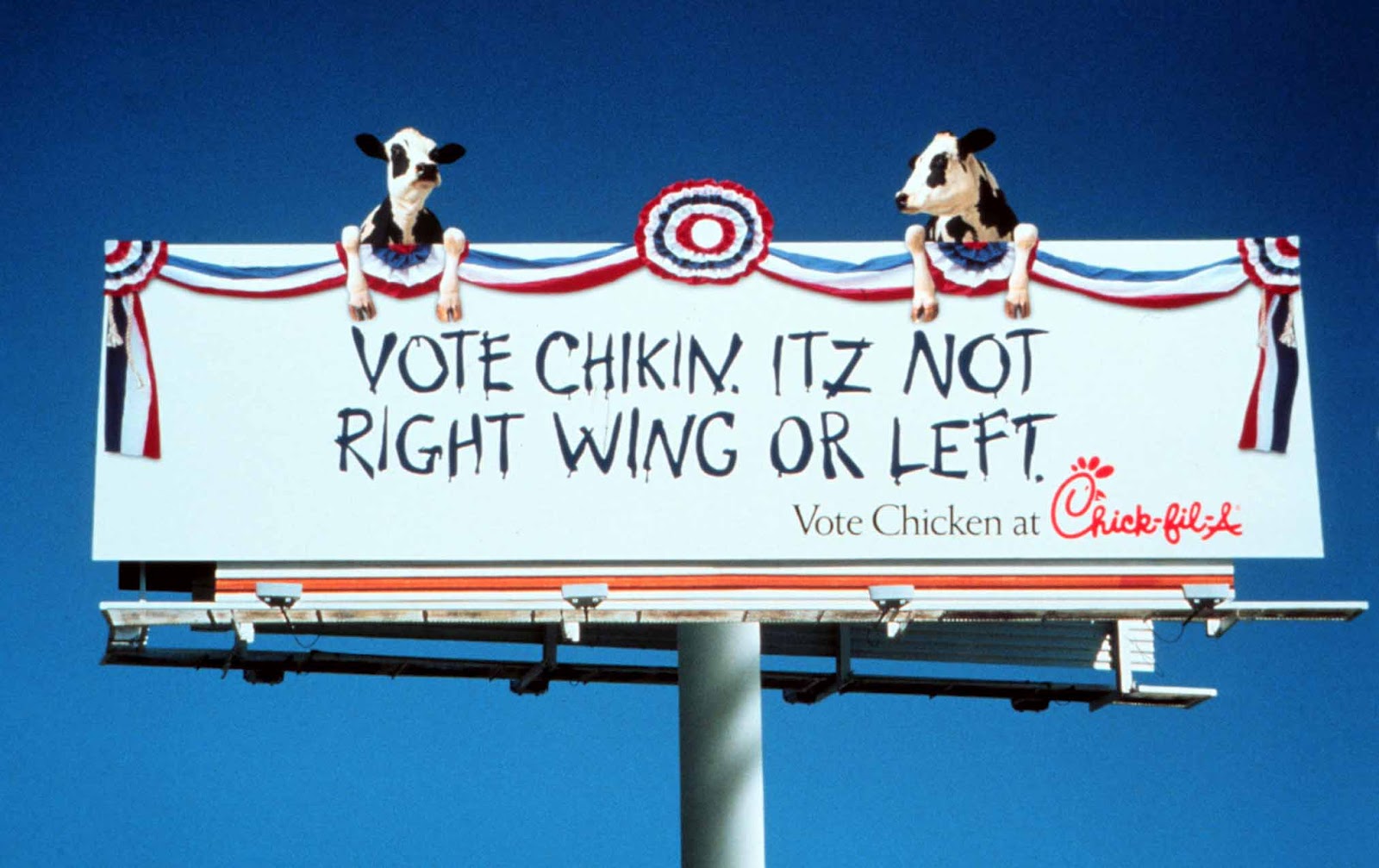
Politics Blog 2: Chicken is Money. Money is Speech.

I’d rather not rehash the whole Chik-Fil-A thing, but I want to cover why it was important. In 2010, in the case of Citizens United  v Federal Election Commission, the Supreme Court ruled that the First Amendment prohibited the government from restricting independent political expenditures by corporations and unions. In other words, corporations and unions can give unlimited money to political campaigns because a) corporations and unions are people, whose freedom of speech is protected by the Constitution and b) money is speech.

You’re thinking, “Who cares? I don’t own a corporation, belong to a union or have a ton of money. So why does this matter, and what could this possibly have to do with Chik-Fil-A?”

Here’s why it matters. You have a limited amount of income that you’re willing to donate to a political campaign. Most of the people reading this will either not contribute to the Presidential campaign this year or will contribute less than $50. If you do give to a campaign, it will be based on your own personal political leanings. However you will give every penny you make to corporations in exchange for goods and services without regard to their political leanings. Corporations have way more money and way more incentive to give to political campaigns. Elected officials create and enforce legislation that has a direct impact on their earning potential, so they are much more likely to donate based on their business interests rather than the interests of the country.

Warning: This is where I’m going to start sharing my opinions. If you’re offended by the opinions of others, this is your chance to just stop reading.

So why was the Chik-Fil-a hubbub important? Because it exposed the fact that they donate a copious amount of money to political action committees that lobby for policies that directly contradict my personal philosophy. Specifically, they spend money to prevent gay couples from being allowed to get married, or to share any of the legal benefits of being married. So I had to make the decision to no longer spend money there, because I didn’t want my money to contribute to a cause I don’t believe in.

We have one vote, but we have lots of dollars. Now because of Citizens United we must spend those dollars with the same caution with which we cast our vote. This is difficult for me, because I like to spend willie-nillie on things I want without wondering if my purchase is going to keep gay couples from getting married. I wouldn’t buy tuna from a company that snares dolphins with their nets or buy shoes from a company that uses child labor in a foreign country. It’s the same principle. The money we spend for the things we want has an immediate and direct impact on our lives and our world. And it means even more since the Citizens United ruling.

This political cycle or the next will likely bring this to a head. We’ll find that there’s a limit to the effectiveness of money. At a certain point, campaigns will have more than they can spend. They’ll buy all the TV time they can, and they won’t sway any more voters by spending more money. The effect of monetary volume has a limit. The bigger risk is of course that corporations will expect favors in exchange for their contributions.

We’ve been here before From around 1830, with the election of Andrew Jackson to around 1881 with the death of James Garfield, this was called “The Spoils System”. Huge campaign donors were given government jobs in exchange for their donations. We ended up with a government full of people looking out for their specific interests who were also not especially qualified to do the jobs they were given. That included not just political appointees but elected officials as well. Back then it was political bosses pulling the levers rather than corporations, but the effect is the same. Bosses were rich guys who usually owned the newspapers (and later the radio stations) in their regions. Their realm of political control was called a political machine. Selling political appointments was made illegal at the end of the Gilded Age. Political Bosses continued to weild power through the Great Depression. But eventually people were exposed to opinions that came from outside their bosses area of control. A few couragous politicians, who were put in place by the machines revolted and the system was changed.

Last time around the whole mess lasted for around a century, but so did newspapers. Technology changed much slower back then, so it took longer for the things influencing people to change. Now we can be exposed to new and different ideas because of our ever changing technology. We are closer to a one-world-experience than most Americans would admit. When people finally get sick enough of the current system, they’ll look beyond their pre-programmed news services and start to demand a change. Once the cry for change is loud enough, a few courageaous politicians will revolt against the system that put them in place and we’ll once again experience one of the bloodless revolutions that make America great.

Small Words

analysis no one asked for

WIL WHEATON dot NET

50,000 Monkeys at 50,000 Typewriters Can't Be Wrong

nicolesundays

humor. storytelling. general stupidity.

Author, C A Middleton

Part time actor, aspiring writer of poetry and prose and full-time idiot with a heart.

On The Heath

where would-be writer works with words

Thoughts of the Fallen

A collection of nonsensical words thrown together

Gabriel and Hare

Hare Philosophy. Location: Virtual Bookshop cafe

petescully

postcards of the hanging

ann e michael

Poetry, nature, books, & speculative philosophical musings

ideas.ted.com

Ideas change everything

Shelley Sackier

I write books--cuz I love words. Sometimes they love me back.

DoubleU = W

WITHIN ARE PIECES OF ME

Too Stupid to Travel

A travel blog for those of us who get lost, stay lost, and make poor decisions throughout.

The League of Mental Men!

A Satirical Word In Your Shell-Like Ear

Life Inside My Head

Random bits of nonsense, hurling thru cyber-space at the speed of thought.

oncloud9andahalf

A Day In the Life Of A Cloud